The University of Galway eight that won the 2014 National Championship reunited as Boat 1 at THOR 2026. Cox Ruadhán Cooke looks back on the crew and the culture that shaped it.
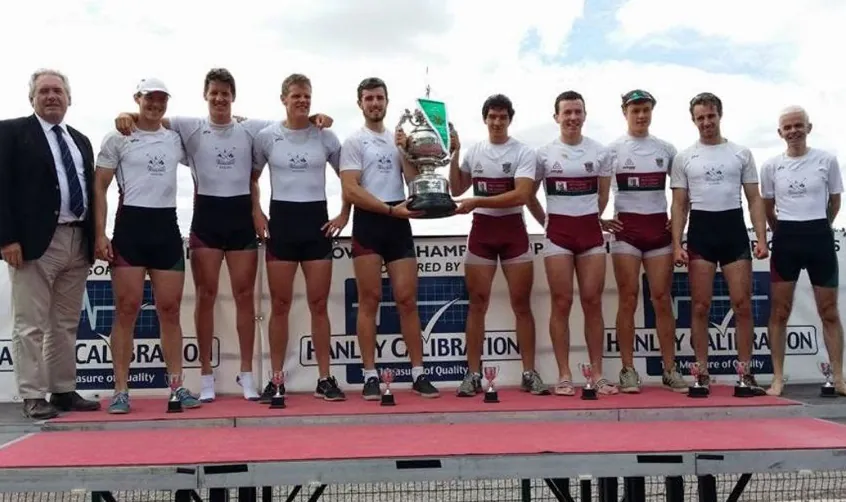
Leading the field this year as Boat 1 is a crew with a special place in Galway rowing history. The men who line up here formed the University of Galway Senior Men’s Eight that won the 2014 National Championship, the last Galway-based crew to capture the blue riband event of Irish rowing.
That victory was not a moment in isolation, but the culmination of nearly a decade of work together. Many of the crew had been racing alongside one another since the mid-2000s, building a record that included multiple national titles and a remarkable consistency at the top of Irish rowing. Their success reflected not just talent, but a culture of discipline, friendship, and collective ambition that defined the NUIG senior squad during that era.
Guided from the stern by cox Ruadhán Cooke, the crew represented a generation shaped by legendary coach Tom Tuohy, whose influence helped establish a tradition of excellence in rowing on the west coast. Over the years, that group became known not only for its results, but for the spirit with which it raced, competitive, determined, and deeply connected as teammates and friends.
Today’s reunion is less about reliving past victories and more about celebrating that shared journey. For many spectators along the banks of the Corrib, these athletes represent a golden chapter of Galway rowing.
As they return to the water together once again, Boat 1 carries not only experience and pedigree, but also the enduring camaraderie of a crew that truly was, and still is, a band of brothers.
We sat down with Ruadhán Cooke to look back on that remarkable crew and the culture that shaped it.
You coxed the last Senior Men’s Eight from Galway, University of Galway 2014, to win a National Championship. What do you remember most about that race?
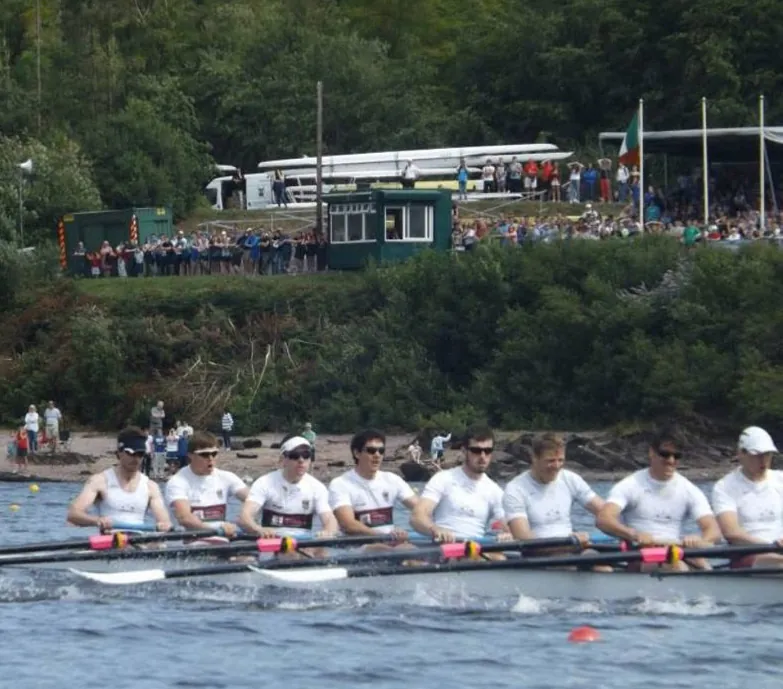
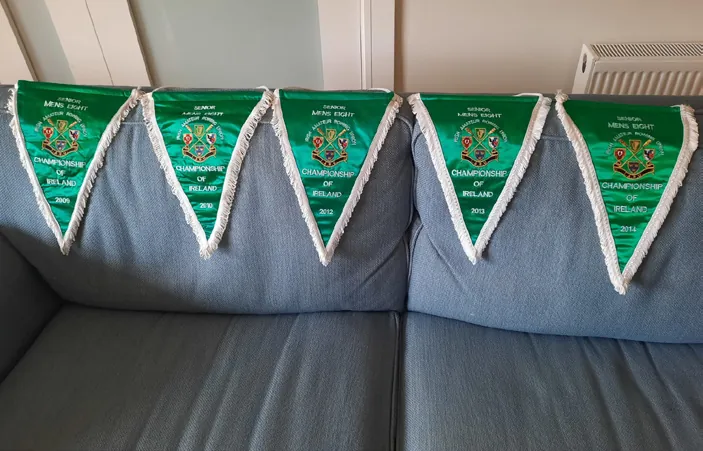
Not a lot really. My stint with that group had begun in 2005, so we had a lot of kilometers on the clock together by then in every sense of the expression. We had won the S8+ Championship in 2006, 2009, 2010, 2012 and 2013 and were runners-up in 2005, 2007 and 2011. Over that period, we’d had a drip-feed of guys moving on and “new” guys coming in. However, from the 8+ that finished 2nd by a foot to Commercial (stroked by Niall O’Toole) in 2005, there were still 4 rowers and me as cox. I think we, the older guys, were a little “war weary” and maybe weren’t enjoying it as much anymore.
Despite leading from about 750, my abiding memory of that race is a comment by Cormac Folan after our narrow win along the lines of “Jesus, we made hard work of that” and “Those young pups from Trinity shouldn’t have been that close!” The younger lads, Fionnán Tolan and Kevin Neville, were winning their first Senior 8 Championship, Richie Bennett his second and Rob O’Callaghan his third “Pot” in a row while still only 20, so we were delighted for them.
Looking back, what does it actually take to win a National Championship in rowing? What separates the crews that win from those that don’t?
In the grand scheme of things, an Irish Senior Championship isn’t a big deal, but for anyone lucky enough to have won one (or 21 like Alan Martin), it’s still special. It’s probably even more special for someone who hasn’t! I think the bigger the boat, the bigger the achievement, because there are so many more moving parts, and the dynamics are that much more complex. The 8 is obviously the biggest boat and the S8+ is at the top of the pyramid, making it the hardest one to win. At adult level also, 9 individuals are starting to have other more pressing distractions in their lives, so a lot of things have to come together for the unit to win.
Almost invariably, the crew that wins is the one that deserves it, usually because it rows better, has trained better, works as a unit better and is able to dig deeper when it matters. While I don’t think there is such a thing as a “lucky win” in the MS8+ Championship, a bit of good fortune doesn’t go astray either. Some really good crews end up not winning because they happen to come up against a generational group of rowers. In my first “career” at Senior level, from 1990 to 1992, Neptune were in their pomp and we were the “bridesmaids”. When the shoe was on the other foot in the 2000s/2010s, Queen’s University had the misfortune to have us as their main rivals. They finished second to us in 2009, 2010 and 2012 by a cumulative margin of less than half a length! Our Doctor of Philosophy in residence, Evin Donnelly, invariably puts it best. Paraphrasing, he contends that races, even close races, are rarely won on the day but in the small margins that are gleaned and accumulated session by session over months, and sometimes years.
What made that particular crew special? Was there something about the group, the mentality, or the way you trained together?
I wouldn’t say that that particular unit was exceptional per se. The previous year’s crew was the best 8 I ever coxed, and I’ve been coxing since I was 14 (I’m 53 now). However, the senior men’s group in NUIG from 1999 to 2015 was a special and exceptional bunch of men; men who were technically and physically gifted, but more importantly phenomenal human beings. You hear a lot of guff in professional sport these days, particularly rugby, about “culture”, “values” and “process”. But we really did have a culture of excellence, ambition, decency and outrageous fun. The younger fellas coming in absorbed those vibes and standards by osmosis. We had a number of natural leaders who gave great example. Assholes just weren’t tolerated and over-sized egos were mercilessly cut down to size.
Our boats were picked on merit and not reputation. It’s a metaphor that’s over used but we really were and are still a “band of brothers”. We shared triumph and tragedy, agony and ecstasy and the best side of us always shone through when confronted with the adversity of life. We were, and continue to be, there for each other in sunshine and in sorrow.
How important was the coach and the coaching structure to the success of the crew?
The above-mentioned “ingredients” of the “recipe” wouldn’t have come together without the chef (chef in French means boss). The big chief was Tom Tuohy (RIP). Tom’s reputation as a mould-breaker for top-level rowing in the western half of the country is undisputed. Where Tom excelled was knowing how to get the best out of guys, appreciating what he didn’t know and, by the time this particular crop came along, he knew when and how to trust the senior members of the group.
In some respects, we were a board of directors, but Tom was the CEO. He was ably assisted at various times and in various different ways by others such as Pete Heaney, Mike Gaffney and Seán Carolan. After Tom’s untimely death in 2011, Seán and John Walsh agreed to “curate” the group’s wish to win in 2012 as a tribute to Tom and his family, wife Breege and children Deirdre, David and Eimear. That was a very successful partnership. Seán subsequently guided us to two more victories in 2013 and 2014. Seán had a very different style to Tom’s, but it was a perfect fit for us and at that stage of our trajectory. A Senior 8’s winner himself, Seán has a phenomenal technical eye and unequalled rowing knowledge. As for “process”, we had a method that we trusted, quality ingredients and, provided we followed the recipe, the result tended to look after itself.
As the cox, what is going through your mind during a championship race? What are you watching for and thinking about?
Personally, the bit I like least about competitive rowing is competing. On race day, from my perspective, all that I care about is not fucking up, or to quote that other great philosopher, Roy Keane, doing my job. It’s not complicated but still not easy: get on the water on time, roll out a quality warm up, get on the starting platform without any drama, make sure everyone is serene and ready, get off the start clean and straight and, from there, preside over “doing our thing”.
An analogy I use for how we raced was that we were a finely tuned and well prepared clockwork mouse. Once we were wound up and placed on the track, we just let go of the key and the rest took care of itself. We never believed in over-choreographed and unnecessarily complicated race plans. Watch the starter’s hand and “Go” on the flag, after about 35 strokes, find the “magic number” that delivers “easy speed” and, at the different way-points down the course, go through the gears to cross the line first.
In my opinion, my biggest contribution to the different crews I coxed was to extract maximum benefit from every training outing on the water. I always tried to ensure that we didn’t just go through the motions, and that we delivered on the high standards we had for ourselves. I think we had really good clarity about what we wanted and needed from each session. The “happy place” that I go to in my head in moments of darkness is not winning races, but rather training spins on different stretches of water. I can feel the cold or the warmth on my face, smell the peat or the heather, hear the beating of a swan’s wings, spit mayfly out of my mouth and re-live the elation of suspended animation and the near perfect synchronicity of beautiful rowing. It’s both spiritual and transcendental.
The role of the cox
For people who might not know rowing well, what exactly does a cox do during a race?
The cox is to a rowing crew what the jockey is to a horse, or the driver to an F1 racing car. That applies equally to training and racing. Depending on the type of race, the steering demands will be different. Otherwise, the cox is like the co-pilot in a rally car, delivering the pace notes. S/he is also an on-board motivator, coach, psychologist.
What do you personally love most about coxing?
The sensations you feel in a boat that’s being rowed well. I can’t choose between the coxed four or the eight. I love steering well to gain a competitive advantage when required, find the best water, or simply to disrupt the boat as little as possible. I like being able to say the right thing at just the right time, either to keep everyone in the groove, get things back on track or “press the button” to make a decisive move. I love landing a boat perfectly on the dock. See also my remarks above about “going to my happy place” and feeling in perfect harmony with nature and the elements. Most of all, I love the “communion” with four or eight other people, where each of us is a small cog in a bigger mechanism and where the mechanism doesn’t work properly unless each cog is moving and working in exactly the right way. There’s a concept in French called dépassement de soi. Translating literally, it means to pass yourself out, or be greater than the sum of your parts. In many of the crews I was lucky enough to be involved with, we got to experience such feelings of being much bigger than our individual and collective selves.
What skills make a great coxswain?
It’s obviously important to be light, but that’s something that requires no talent. That said, it says a lot about a cox’s character if they are willing to shed blood, tears and sweat (literally) to get down to weight. I think the best coxes are those who realise that it’s possible to get better every time you go on the water. That requires humility, resolve and a willingness to learn, to experiment, to listen, to evolve. A good cox should be assertive without being arrogant, confident without being complacent and know the value of saying nothing. A little mantra of mine is to let the crew know that I’m going silent and to invite them to “listen, feel and enjoy!” Bad language never had any place in my lexicon! Over time, a cox finds his/her voice and develops a style that reflects his/her personality. I’m still learning and it is actually possible to teach an old dog new tricks.
How important is the relationship between the cox and the crew?
Coxes can be functional and do the job that’s required. Sometimes that involves just steering adequately, not hitting anything and saying nothing, and that’s fine. But sometimes the complicity between cox and crew is a rare, special and beautiful thing that can make the difference between winning and losing. I’ve had the good fortune to have experienced that with a number of different units. It’s almost impossible to describe but once you’ve experienced it, it’s a sort of nirvana that you aspire to. We “give each other the eyes”, and we all know what that means. I’ve had the privilege to sit in the cox’s seat facing the great James Wall who stroked five of our winning Senior 8s and, book-ending the 2014 unit in the bow seat was another great, Dave Mannion, winning his seventh S8’s Championship!
I have to mention also our hero and guardian angel, Paul Giblin (RIP), who stroked the 2006 Eight to victory. On the start that day, he reached out to shake my hand and asked “Are you ready for the ride of your life?” It still sends shivers down my spine. Tá sé inár gcroíthe agus inár smaointe i gcónaí.
What advice would you give to someone thinking about becoming a cox for the first time?
Have a go. Take the risk of falling madly in love with an activity that is exhilarating, empowering and enduring. There’s the wonderful Jim Heney, who coxed the winning UCD S8+ in 1971 and, at 80 years of age, he’s still coxing with the mighty men of Old Collegians. Animals!!
Developing coxes
Coxes are often hard to find in rowing clubs. Why do you think that is?
To be very blunt, I think they are taken for granted, undervalued, not given the training needed, treated like dogsbodies, and ultimately disrespected. Unfortunately, all too frequently the cox isn’t made feel like a crew member and team mate of equal worth, value or importance. It’s not really surprising that so many just give up. When clubs finally realise that they haven’t invested in their coxes, it’s too late. Those that do stick it out, are hardened like diamonds, and are both rare and precious!
How can clubs like ours encourage more people to try coxing?
Do exactly that, encourage people to give it a try. Then be patient. Mol an óige (and the not-so-young) agus tiocfaidh sí! If you can get someone to “bite”, then there’s a good chance they’ll be “hooked”.
Tribesmen and THOR
This year your crew reunites in Boat 1 at the Tribesmen Head of the River. What does it mean to race on the Corrib in front of the home crowd?
It’s an honour that we are being celebrated and remembered in this way, but I’m not sure how “racy” we will actually be. I hope we don’t get stage fright in front of the grandstands!!
What are you looking forward to most about this year’s race?
Being together again with my Boys in the Boat. It’s a bit like that scene out of the Blues Brothers film where Elwood and Jake are getting the band back together. I hope we remember some of our greatest hits! In any event, I’m looking forward to a post-race lemonade with the buachaillí.
If you had to describe that Eight in three words, what would they be?
Cruinneas, crógacht agus cáirdeas!